Govardhan Puja: Thanks Giving Day to our Parents- Lessons from our Puranas

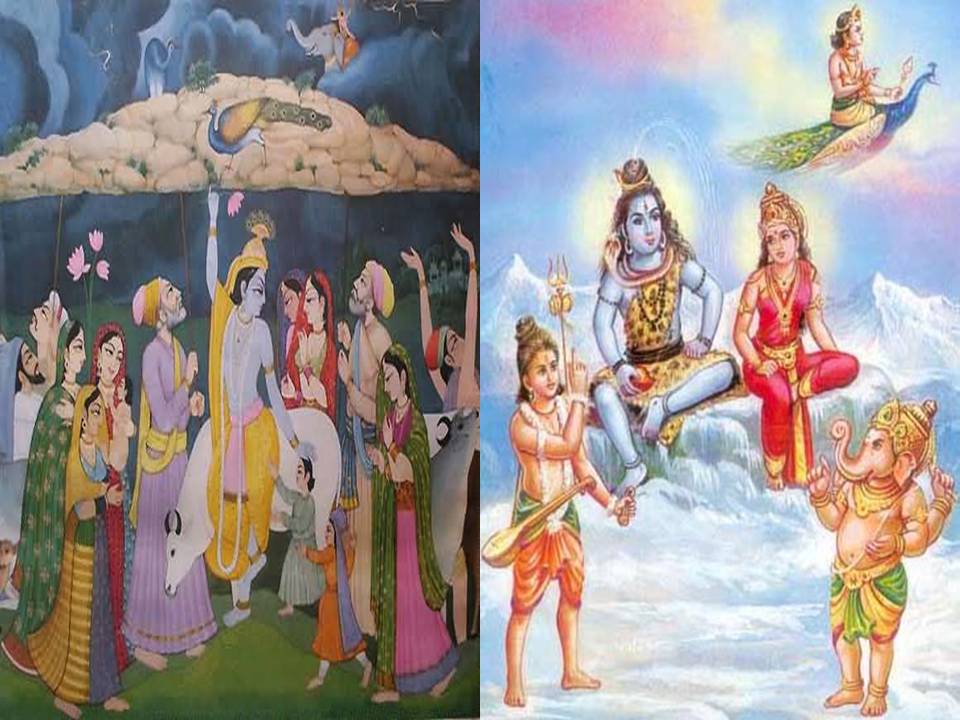
Today’s the fourth day of Diwali festival and Hindus across the world celebrate this day by performing Govardhan Puja. Govardhan Puja reminds me of stories I had learned during my childhood. In this post I’ll share those two stories and lessons from our Puranas. Story 1: Krishna was playing with his friends when he saw villagers of Varindavan carrying eatables for a Yaga to please Indra, the God of Rains. Krishna asked them why do they pray a God who’s so distant and instead they should pray Mount Govardhan which actually brings rains and provide food and shelter to so many creatures. He initiated a festival that paid respect to Mount Govardhan by offering food and many other things. Krishna then assumed the form of mountain and accepted the offerings of the villagers. Indra got very angry upon seeing shift in the devotion of villagers towards Krishna and Mount Govardhan. To teach villagers a lesson he directed lightning storm and heavy downpour upon Varindavan. To protect the villagers from the calamity, Krishna lifted the Mount Govardhan on his little finger and the entire village came under Mount Govardhan to take shelter from storm. Indra after causing such heavy downpour for seven days ultimately gave up and bowed to Krishna’s superiority. Click here to watch the story. Story 2: Once Maharishi Narad gave a divine fruit to Lord Shiv and Mata Parvati and told them that whosoever will eat this fruit will get supreme knowledge and immortality. Kartikey and Ganesha, sons of Lord Shiv and Mata Parvati, both wanted to eat that fruit and both requested their parents to give the fruit to them. Now the situation was tricky as whom to give the fruit. So Lord Shiv told them whoever will circle the entire world seven times and come back first will get the fruit. Listening this Kartikey took his vehicle, Peacock, and started his journey around the world. On the other hand Ganesha’s vehicle was mouse and he thought he can’t defeat his elder brother by riding mouse. So he thought what does the world mean to him and who’s his world. Ganesha loved his parents and whoever we love, becomes center of our lives and all our life energy goes into it. So Ganesha circled his parents, who were his world, seven times and got the blessings of his parents. Ganesha was adjudged the winner of the race. Hence he was given the divine fruit. Click here to watch the story. These two stories, and lessons from our Puranas, remind us that our parents are our Mount Govardhan and our world. All their lives they try and protect us from all the evils and difficulties. They provide nothing but the best of means to grow and help us excel in our lives. When the whole world is performing Govardhan Puja today by circling Mount Govardhan, let’s all Thank our Parents for all the sacrifices they have made and all they have done to ensure our well being and make us what we are today. May God Bless everyone’s Parents!

How to Choose your Training Partner and Plan for an Out Bound Training Program?

When was your last out bound training program? Did you have fun? Remember the take away of your out bound training program? I am really happy if you do but after having met and spoken to several connections in the industry, I am afraid that we do not remember much of the take away. Reason, is simple – the industry is facing a price war, a competition with the event companies that are slowly moving towards corporate companies to tap parts of their employee events. Corporate companies welcome these companies largely for two reasons – Price and Relationships. I must say, some of the ‘team building companies’ are very good as the people behind them are experienced, come from training industry and launched themselves right on the identified gap by the event industry. Training Companies are going through a robust change, at 2 levels some are adding value in delivery mode though right training simulations and content expertise. Others are cashing on low budgets and have found their space between team building activities and employee retreats. There are few who have created a perfect amalgamation of team activities & retreats and have labeled the product offering as ‘corporate retreats’. The idea here is, to understand the thin line between Outbound Training Programs are corporate picnics, which are being framed as a popular jargon ‘corporate retreats’. Here are few pointers, which you as an HR must understand to plan an Out Bound Training Program: Know Your Audience As the training organizer or coordinators, it is important to streamline the audience. You cannot plan an event for all in entirety. Understand the purpose of Program The most significant aspect of having a program is to work on the design & delivery of the program which is only done by a trainer who understand the competency model of the program. This is equally important in context to the previous point, you need to understand the audience. When we design programs, develop content – the primary facet of the same to understand the audience, competency mapping of the audience and then developing the program for them. Use Science & Technology to its Best The very purpose of a training program is – adding value to your team, your employees and to upgrade their professional capabilities. Training Industry is upgrading to simulations, it is about the science of training largely designed on the basis of neurosciences and how effective they could be in adult learning techniques. Differentiate between OBTs and Retreats Once you have understood the above requisites of an upcoming program, you need to clearly demand the training partners- they need t differentiate between an OBT and a retreat program. Retreats are good for team rejuvenation but OBTs are different and need to be focused and result oriented. OBTs should cover the following: Audience Orientation aligned with the KRAs. Outdoor activities should be about Positive Challenges to your team, mental as well as physical. Team Games is not all an OBT needs, there has to be a defined cause & effect for each training element. Action in an OBT needs to be completely allied with the learning objectives which a training partner should design with Reporting Managers of the audience or the HR. OBT Objectives for the Trainer As a trainer, I believe little bit of customization and tweaking is required as per the industry, the audience, their job profiles and KRAs. Some of the standard objectives however will be, Structure the training program based on brief of HR, Employee roles and program design. Make your participants comfortable and be appealing throughout the program. Align the learning objectives with the OBT activities. Aptitude & Ability to understand the profiles, and interact with them to understand the problem areas. Deliver lessons sensitively but keeping the OBT environment light & candid Firstly, you need to understand the need for certain training program, plan it in a structured way, define goals for a program, explain it to the team and bring the training content in sync with the client requirements, follow & inculcate the above trends and now you are good to go. In case you need any further help on choosing  your Training Partner and plan for an Out Bound Training Program, feel free to write to me on, [email protected].

Har Har Mahadev- Each One in Himself (People Empowerment Perspective)

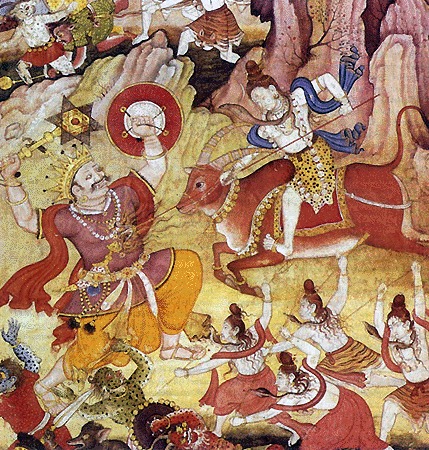
Our ancient literature and mythological books are full of stories – citing friendship, faith, dutifulness, leadership, dedication, compassion etc. Like always, I get ideas – relating their perspective to our jet age life, where I deal with people at various levels in different organizations. Being a L&D professional I have been working on bringing change to organizations and wondered if I could really link the very phrase‘Har Har Mahadev’. We all have heard this phrase several times in temples, in recitals and in prayers. The perspective clicked to me while reading about the Dharamyudha in which Lord Shiva, the Mahadev as explained by Amish in his book, coined the phrase to empower his team of warriors. I learned a new perspective of people management and people empowerment while reading this particular part in the story. It is the battle field and the entire team is ready to work for the betterment of their reign and its people. The weak, the strong, the proven and the laggards – all want to contribute and excel. Identifying traits & Leadership Style In ancient times, it was one God, one king or one leader for all. The delegation though happened in those times too but was only limited to the set of duties. The belief and onus of responsibility was put on just one person of each clan – in this case, it is the ‘Neelkanth’ – who was believed to be the messiah for the people of Meluha who waited for him to come & fight for their rights and save them from the Chandravanshi’s and the Nagas. Now the ‘Neelkanth’ has arrived who is like a new leader who is given the onus of leading the state in the best way possible, as per the rules laid by the state which has its own weaknesses and threats owing to the idealism and self belief of the population. He is trying to get into the system as he apparently is highly opinionated and believes in Karma – the good and bad. He is someone who doesn’t believe in being restricted by the man-made rules and believes in the Power of Expression, Equality and Performance over scores & class. Now isn’t that something which we all are aiming for in life and more importantly in everyday work life? We all try each day to strike a balance with our leaders (read bosses) who we want to be non-biased. A participant leader is always a welcome in a career life. It leads to mutual growth and understanding. It is the thing everybody hopes for to make the journey pleasant. Authority If a person seems important to us, we listen to that person. The person who is perceived as an outsider suddenly is been looked up to and heard of as a leader, a savior. Reason – we feel the person is important, possess power and authority and can help us gain benefit. Authority is a decisive adjective and that is why people in authority shall be chosen with great discretion and in full faith. While Shiva coined the term ‘Har Har Mahadev’ for his team, he wins hearts and trust of his team. Because he embraced authority with great liberation and he shared his power with his team by delegating the authority and empowering the meritorious. In the mentioned Dharamyudh its ‘Drapaku’ who is made the leader by Shiva for his pure talent & patriotism for the state. People Empowerment The above two are only considered worthwhile if they are used for the growth & up-liftment of the team, the resources and are made to work towards a goal which will yield results that are good to the people, the organization at large. Where it is the contribution and the result that matters most, the delegation of the team is done as per the skill-set possessed by each of them and where the sense of belongingness is inculcated deep within. The story about inception of the phrase ‘Har Har Mahadev’ guided me to the base of this human resource practice. It is about the following qualities which enable employee empowerment. When Lord Shiva told his team that it is not about him being a Mahadev but it is that each one around is a Mahadev in himself. Here, he is bringing in the concept of people empowerment and bringing in the sense of belonging which is currently practiced as ‘Employee Management & Industrial Relations’. This is what the current day HRM practices aspires for. Team, group dynamics and synergy are not just terms – they really carry a lot of meaning & weightage. The age old literature, the history vouches for it and the present day start-ups seems friendlier towards it. They value individual traits, personal skill-set, personality and interests more than the KRA, the task at hand and the targets on paper. The ancient mythological philosophies certainly carry a lot of management lessons and this is what stuck my mind when I read about ‘Har Har Mahadev’. Particularly if we talk in context of team empowerment, participant leadership, passion & compassion before rules, Lord Shiva gives me so many relevant stories.

Delegation in Ramayana (Mythology & Management)

Stories are the best ways to overcome obstacles of learning. While I was working on a leadership program I came across two stories from our mythology which helped me to explain the concept of delegation to my trainees. In this blog, ‘Delegation in Ramayana (Mythology & Management) I’ll share both the stories and how these stories explain the delegation. First Story Lord Ram helped Sugriva to regain his honor and made him king of Kishindha. Sugriva and vanars decided to help Lord Ram unite with his wife Mata Sita who was abducted by demon Ravan. The entire Vanar army was divided into four groups and sent in four directions to find Mata Sita. Hanuman, Angad and Jambavantha with their group reached the southern seashore. They met Sampati, a vulture, who tells them Mata Sita was abducted by Ravan and is sitting under a tree in Lanka, which is on the other side of the ocean. Upon encountering the vast ocean, every vanara begins to lament his inability to jump across the water. Hanuman too is saddened at the possible failure of his mission, until the other vanaras and the wise bear Jambavantha begin to extol his virtues. Hanuman then recollects his own powers, enlarges his body, and flies across the ocean. After he finds Sita in captivity, Hanuman reveals his identity to her by giving her ring of Lord Ram. He reassures her that Lord Ram has been looking for her. He offers to carry her back to Lord Ram, but she refuses his offer, saying it would be an insult to Lord Ram as his honor is at stake. She gives her jewelry to Hanuman Ji and asks him to give it to Lord Ram. Second Story To seek a peaceful solution, Lord Ram sent Angad as messengers to convince Ravana to return Mata Sita peacefully. As this was the only way to avert the war. Angada tried every means to convince Ravana, but he was firm to face battle instead of returning Mata Sita peacefully. Angada planted his foot firmly on the ground and challenged anybody in the courtroom to uproot his foot. If anybody were to accept the challenge and was successful, Lord Ram would concede defeat and return without Mata Sita. All the commanders of Ravana’s army and even his son ‘Indrajit’ tried to lift Angada’s leg but none succeeded. Feeling humiliated by this failure, an infuriated Ravana slowly walked towards Angada’s planted foot and just as he was about to hold Angada’s leg to attempt the challenge, Angada moved away and Ravana fell down. Angada explained that the challenge was for Ravana’s commanders and not for Ravana. He told that Ravana was prepared to fall on his feet but instead he should choose to fall on the Lord Ram’s feet, for those are the ones that remove fear of cycle of life & death. He then picked up Ravana’s crown which fell down on the ground and threw it out of the palace. Ravana ordered his men to kill Angada. But he took a jump and flew back to the place where the Vanara army was gathered. Lessons: Mythology & Management These two stories give us very important lessons of management in purview of Delegation. See Lord Ram as CEO of company and observe the power of delegation being expelled and carried off by him. When the thought struck my mind, I got another reason to reassure myself that management certainly is a derivative of mythology. Lord Ram, put across the problem and took up a discussion to suggest solutions. He was aware of his team strengths and weaknesses.  Lord Ram also knew about the importance of each task to their organization and the task @ hand. Accordingly as per the skill set and the importance of task – he further went on to strategic delegation among the team. That is the reason why Hanuman in story 1 was assigned the task to find Sita and to reconfirm her presence at the Ashok Vatika. He was assigned the task based on this physical skill set and presence of mind. And Sita like an ardent associate understood the importance of task delegated and din’t asked for any further help or assistance. In management context, an extension further to delegation leads to imbalance and hence grievance. And that is why the delegation holds lot of importance. Coming to the second story, Angada was delegated a task of authority. He was a messenger deployed to discuss the suggested way out, to avoid war. His skill set included assertiveness, authority, communication skills and he knew temper control which wasn’t a case with Hanuman as he was an emotional devotee of Lord Ram and would never listen to any ill words for Lord Ram. Lord Ram knew of his skill set and his power. And hence the delegation was done accordingly. These two stories embark all the 5 Stages of Delegation. Where Lord Ram, observed and realized the strengths of his team members including Hanuman, Jamavanth and Angad. He evaluated the situations and the employee skill set, he made sure of the circumstances and allowed his team to collaborate and that’s how he delegated.

Journey to Excellence

Have you ever wondered what is the definition of Best? What is definition of Excellence? What is the definition of Perfection? Here is a small story which not only helped me to understand the meaning of The Best, Excellence and Perfection but also guided me towards journey to excellence. In ancient Rome, Romans had a very large number of Slaves. The behavior of Romans with their slaves was very cruel. Even for slightest mistakes the slaves were punished very harshly. Killing slave was not an offense in Roman law and Romans used to explore new ways to torture their slaves. If any of the slaves tried to escape from his master, there was only one punishment, slow but very painful death. This was also used to refrain other slaves from running. All the roads were well protected by the Roman army and a big jungle was the only place where slaves could hide themselves. But the jungle was full of wild animals and it was considered impossible to cross jungle without any protection. Romans calculated if someone was to cross the jungle successfully he will have to run like a leopard else he will be chased and killed by wild animals. It needed a superhuman to run at such speed hence Romans never tried to protect the road leading to jungle. Still in ancient Roman texts there are tales of many slaves who were able to cross the forest successfully and live a free life. When modern medical science came to know such stories they started testing human body if it was capable of running long distances at fast speeds. After so much of research medical science concluded that human body is incapable of taking this much of stress and if someone tries to run faster than the maximum speed described in the study his blood pressure will rise to such a level that he will die of a heart attack. They gave a bench mark that a human can’t run a distance of 400m in less than 50 seconds. On 29th Sept. 1900 Maxie Long of USA covered 400m in 47.8 seconds breaking the bench mark set by scientists. Time taken by Maxie was a world record in athletics and he was considered the best. Scientists said Maxie Long has something special that made him capable of covering 400m in less than 50 seconds. On May 27, 1916 Ted Meredith of USA broke this record by 4 seconds. Now 47.4 seconds was the new bench mark. On 18th Oct.1968 Lee Evans of USA covered the 400m in 43.29 seconds to reset the new bench mark. On 17th Aug. 1988 Reynolds set a new world record to cover 400m in 43.29 seconds. A new bench mark. And on 26th Aug 1999 Michael Johnson of USA made a new world record and covered 400m in 43.18 seconds. Michael Johnson’s world record still standing tall and has not been broken. Today how many of us know Maxie Long of 1900, let alone remembering him. People talk about Michael Johnson of 1999 and they will talk till a new athlete comes and reset the bar higher. In last 100 years the bench mark in athletics has been reset at least 25 times by different athletes. No one talks about athletes who were the best of their times and raised the standard to new levels. We remember people who keep raising the bar continuously and keep improving their own bench marks. Yesterday’s best can’t always be the best. It may not even considered to be good tomorrow. So what is the Best, Excellent and Perfection? There is nothing called Best, Excellent or Perfection. It is all about improving, getting better and better and raising the bar to next level. Hope you too are on your Journey to Excellence. Happy Journey!

God’s Companion

Have you ever wondered why do people take birth? What makes them take birth? They have friends, relatives, companions. Who is God’s companion ? Here is a small story, I was told in my childhood and the lesson to be learnt. God is one and he is the supreme power. Because God is one so he feels very lonely and he is very tired of his loneliness. He wants to have a companion with whom he can talk, play and spend time. So what he does is he makes his replica, a sculpture, of sand and then he adds life to it and examines if it is worthy enough to be God’s companion. If he finds any drawback/ weakness in his replica he throws it on mrityulok (earth). And here on earth human take birth. We are exactly like him, his true replica. We have most of his strengths and yes! some weaknesses too else he wouldn’t have sent us to earth. The day he will be successful in making his true replica, his eternal companion, he will stop making other sculptures and then no human will take birth on earth. I believe every bit of this story and I am firm believer that the mankind has been blessed tremendous potential. I wonder when people say they have so many weaknesses and only they want is to get rid of their weaknesses and not to work on their strengths. They forget that they were created by God to be his eternal companion. Story of a child There was a child, who was considered as a bully, a school dropout. Normally one would consider him to be someone who will struggle in life but this boy was different. He had a special talent of batting. He started practicing in nets for hours. When he was aged 16 years and 205 days, he was picked up to represent India against Pakistan. He made 15 runs in the first test he played and was out on a ‘duck’ in his first international one dayer. But so determined was he that he wrote history in international cricket for being the first player to score a century of centuries. There is hardly a record which is not under his name. When he decided to say good bye to international cricket after playing for 24 years and was to play his last test (200th test) at his home ground ‘Wankhede Stadium’ in Mumbai, he padded up and practiced for the whole day to prepare himself for the last innings of his international cricketing career. Cricket fans who had come there to witness him practice told reporters that he practiced so enthusiastically as if he was practicing for his first game of his career. He scored 74 runs in his last test match and when he got out and was walking towards pavilion he was still thinking he should have played his shot differently. By continuously polishing his abilities he took his career to such a level of excellence that he is became a legend. He is known as ‘Sachin.. The God of Cricket’. Believing yourself, knowing and polishing your abilities can make the difference for you as well. After all almighty had created you to be his eternal companion.  

Compounding- The 8th Wonder

Once there was a king who was very kind. He was renowned for keeping his words and helping the scholars for their wisdom and knowledge. There was a poor poet who came to know about his generosity and came to meet him. He had written a poem which had very high literary quality. The King was impressed and asked the poor poet for reward he wanted for his literary work. The poet pointed towards a chess board which was lying there and asked to place 1 grain of rice on the 1st box of the chessboard, 2 on the 2nd box, 4 on the 3rd box, 8 on the 4th box, 16 on 5th box and double the no. of rice grains till 64th box. The king was surprised to know on his demand and asked the poet to demand something else as this was a petty demand. But the poet insisted on putting the rice grains on the chess board. The king ordered his servants to start putting rice grains on the chess board as per poet’s demand. The servants started putting the grains on the chess. On 20th box the no. of grains was 524,288, on 25th it was 16,777,216, on 30th the no. was 536,870,912, on 35th the no. was 17,179,869,184. On 40th the no. was 549,755,813,888. On 45th the no. was 17,592,186,044,416. On 50th the no. was 562,949,953,421,312. On 55th the no. was 18,014,398,509,482,000. On 60th the no. was 576,460,752,303,423,000 and on 64th the total was 9,223,372,036,854,780,000. The total number of rice grains which the poet won was astonishing 18,446,744,073,709,600,000. This was something which was out of the means of the king. To keep his words to the poet the king handed over his kingdom to the poet and went for meditation in the forest. This is an ancient story which explains the wonder power of compounding can do if one starts investing early, invests regularly and sticks to his investments for a longer period of time. Albert Einstein once noted that the most powerful force in the universe is not the gravitational force but the power of compounding. He even said, “The power of compounding is the 8th wonder of the world”. I am sure you must be wondering about compound Interest and what Compounding- The 8th Wonder can do to your investments. Compound Interest is an interest which is added to the principal amount and the added interest start earning interest. The addition of interest to the principal is called compounding. For example your investment of Rs. 1000/- per year with a rate of interest of 10% would become Rs. 1100/- at the end of 1st year and at the end of 2nd year it would become Rs. 1210/-. This difference may look very small if you compare it with simple interest (which will be Rs. 1200/- after 2 years @ 10% rate of interest). But remember even the no. was small when the servants were putting rice grains on the chess board but eventually compounding made all the difference and the king lost his kingdom. To get more clarity on the power of compounding let me give you an example of two friends Amit and Satish. They both started working at the age of 25 at a same salary package. Scenario-1 (Assuming RoI @ 15% per annum) Amit starts investing at the age of 25 and invests Rs. 5000/- per month till his retirement at the age of 60. He will get an amount of Rs. 5.70 Crore Satish starts investing at the age of 35 and he invests Rs. 10000/- per month till his retirement at the age of 60. He will get an amount of Rs. 2.77 Crore Scenario-2 (Assuming RoI @ 15% per annum) Amit starts investing Rs. 5,000/- per month at the age of 25 and keeps investing for next 15 years. He does not take his money out till his retirement age of 60. He will get an amount of Rs. 5 Crore Satish starts investing at the age of 35 and invests Rs. 10,000/- per month till for next 25 years that is till he’s 60 years of age. He will get an amount of Rs. 2.77 Crore Scenario- 3 (Assuming RoI @ 15% per annum) Amit starts investing at the age of 25 and invests Rs. 5,000/- per month till his retirement at the age of 60. He will get an amount of Rs. 5.70 Crore Satish starts investing at the age of 45 and he invests Rs. 50,000/- per month till his retirement at the age of 60. He will get an amount of Rs. 3.07 Crore The power of compounding is the secret behind the great returns for long term investments. If you have the patience and if you can save and invest, then the power of compounding can do wonders to the investments made. If you have not started investing yet, you can start investing now and can still make good corpus for your retirement. In my next post I’ll share the different avenues of investment. Stay tuned and Happy Reading !!

Sone Ki Chidiya- Learning Perspective

These days when the entire nation is witnessing the vote bank politics. All we listen in the television news is about polls, the 49% women voters, the youth making choices and the country demanding a change – the positive one! On one such day, there was a debate on television where 2 panelists argued on the phrase ‘India – the then Sone ki Chidiya’ and I found that the phrase echoed in my mind for little longer than the usual. Something was disturbing me and I realised that my mind wanted to go back to the history. There was a time our country was called ‘Sone ki Chidiya’ (The Golden Sparrow). This is something we all are proud of. I always wondered how did India get this name ‘Sone ki Chidiya’ and not ‘Iron Eagle’. Who named India, ’the Golden Sparrow’? How did it all start? I hope you are also curious to know the story. So here is the story: India was invaded by many. The first time someone invaded India was Alexander the great. He crossed into India in 327 B.C.E. fought against King Porus. King Porus fought fiercely but was defeated. Alexander wanted to move further towards Magdha, the strongest of Indian empires. But his army refused to go further as they had heard the tales of powerful Indian tribes and they had not forgotten memories of their battle with King Porus. Alexander was extremely disappointed but accepted the decision of his army and decided to return to his capital. Post Alexander departed from India, close to next 1300 years were relatively peaceful and India didn’t suffer any major invasion. Starting 1000 A.D. Mahmud of Ghazni, an Afghan, invaded India several times. He plundered several temples and killed hundreds of thousands of Indians. The booty which he looted is estimated to be more than 100 million Dirhams, several tons of gold, silver and precious gems. While Mahmud of Ghazni was returning to his capital in Afghanistan, one of his generals asked Mahmud Ghazni about why Indians were not showing any resistance and were fleeing from the battle field without caring about their country, their families, savings and whatever they had. Mahmud of Ghazni reminded his general of a game they played in their childhood. They had eagles as their pets and their favorite past time was to watch their eagles fight. In order to make them fight, they used to throw a sparrow in the sky and before it can fly away, their eagles will chase, kill and eat the sparrow. Whosoever’s eagle killed the sparrow, was the winner. Listening this, his general laughed and told Mahmud of Ghazni that they are still playing the same game in India and the only difference is that they are the eagles and the Indians are the sparrows. Listening this Mahmud of Ghazni answered, “Yes! We are eagles and they are the sparrows.. But they are the Golden Sparrows!” This is how India got another name, “The Golden Sparrow- Sone ki Chidiya” as Indians didn’t stand united to face the threats and invaders not only defeated the Indians but also took away the resources. And today when I think about this story again, I wonder what would have been our country like if only, “the Maharajas, Kings, Dewans and then landlords during those times chose to show some resistance and fight instead of giving up to their own fancies, India would never have been called ‘Sone Ki Chidiya’. If we go by the facts in the story there doesn’t seems a single reason to feel proud. Digging deep into the context and trying to find out – how this could have been saved, I got the following answers from within and these are certainly the lessons learnt. Points to Ponder: Escapism: Running away from a problem is not an option instead we should understand, explore, find the solution and then act responsibly. An escapist attitude is never appreciated in any sphere of life – corporate or life in general. We come across many difficult situations but only those who face them patiently sail & survive. Escapism is a complete no in our lives, as emotions may sometime help us in life but here – results matter most. And those who care for results, choose to act. Team Work: No Indian king made any attempt to make a coalition to face the external threats. Had they formed a coalition and challenged Mahmud of Ghazni and other invaders, the story could have been totally different. Attentiveness and Action: As they say, the more you sweat during peace the less you bleed during war. One should always be ready and keep all the options open. During peace don’t stop practicing war. However, sometimes there is nothing wrong in buying time, if there is a grave threat to your existence because of the challenge in hand or a corporate situation is disturbing your work-life balance, one must buy some time, assess the possibilities and act accordingly. But mind you, taking too much time is not recommended. Take risks: Don’t keep waiting for the best time. The go-getters believe in ‘now’. This also comes from an independent & leaders attitude. Those people Take Risk > Lead> Confront> Solve. Experiment: Learn from others mistakes. When Indian kings were losing one by one, no one learnt the lessons and rectify their strategies to confront the Mahmud of Ghazni. Experiential Learning is life long, it offers a different point of view to handle situations, people and circumstances. It is the way of learning during the pressure situations. It is supposedly the only way to come out of those situations. One should rather not get trapped and act smartly. This was my interpretation of story for my corporate trainees who each day go out of home to add some more meaning to life. Stay tuned for more stories. Take Care

Little things matter the Most!

During the beginning of a training session I asked my trainees to give their introductions and also additionally they were told to tell the name of an animal they like the most and explain the reason for their liking. When everyone finished, trainees asked me about the animal I like the most. I told them that I like Squirrels the most as Squirrels remind me that whenever we are given a task we should take it as service to God and should give our 100% to it. They were curious and wanted to know the logic behind the same. I shared an incident from ‘Ramayana’- Ravana abducted Lord Ram’s wife, Sita, and took her to his capital, Lanka. Lord Ram asked Ravana to return his wife but he refused. Then with the help of Vanar Sena (Army) he decided to fight Ravana and take his wife back. They reached the southern end of the land and Lanka was on the other side of the sea and since it was not possible for the Vanar Sena to swim and cross the vast ocean, Lord Ram decided to build a bridge (Setubandh Rameshwaram) across the ocean with the help of ‘Nal’ and ‘Neel’, the Vanar princes. Nal and Neel were very notorious in their childhood and were used to throw belongings of sages in water. They were cursed by the sages that whatever they throw in water will not sink. The entire Vanar Sena started collecting the stones so build the bridge. The army was so excited that they started running around to look for biggest stones. The Vanar Sena was very strong and they brought huge stones and rocks and dropped them in the ocean. The other animals also wanted to help Lord Ram build the bridge. A small squirrel was watching this and decided to help. It thought for a while and started collecting pebbles and dropped them in the ocean. The squirrel worked hard and dropped as many pebbles as it could. Squirrel was tired but still wanted to continue the work so it rolled self in the sand, ran into water and washed. It ran back the shore rolled and washed self again and continued. While he was moving to and fro, it came in the way of a Vanar who was carrying a big stone and just survived from being crushed by Vanar. On seeing this another Vanar picked the squirrel up and threw it towards the shore and other Vanars started laughing. Lord Ram was watching all this and he caught the little squirrel before it fell. He addressed the Vanar army: “ Dear Vanars, you are huge and strong so you can bring big stones and rocks but those big stones can’t be joined perfectly and there are many small gaps between the stones. The pebbles brought by the squirrel have filled the gaps and the sand particles bind the bridge in proper shape and also make it strong. Remember, that in order to achieve something BIG one should not only concentrate on major task involved but one must take care of the small details as each step and all the efforts count equally. If you are working in a team, the efforts of all the team members, however small these may be, must be appreciated!” The Vanars were ashamed and asked for forgiveness from Lord Ram and the Squirrel. Then Lord Ram turned to the Squirrel and said, “My dear squirrel, I am sorry for the hurt caused by my army and thank you so much for helping me building this bridge. Please go back and continue your work.” Then he touched the back of the squirrel and three lines appeared where Lord Ram had touched him. Now whenever I see a squirrel, the three lines on its back reminds me that every task however small it may be, is important and significant in its own way and we should appreciate each and every contribution made by a team member (in personal or professional lives) to achieve something.