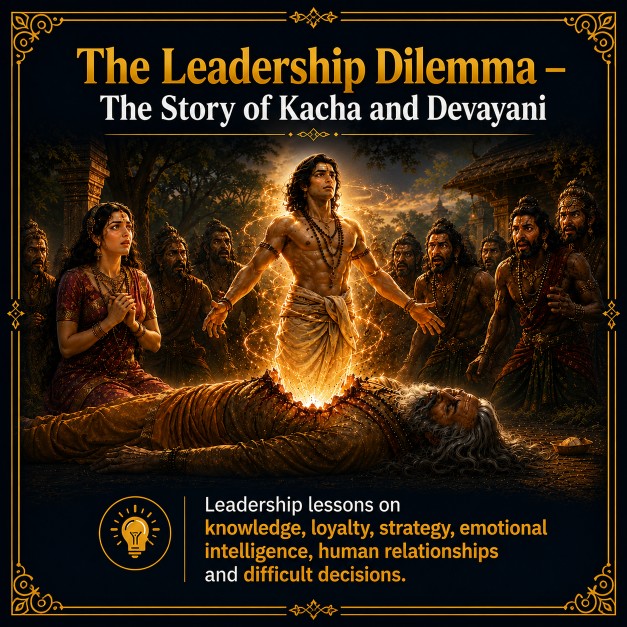
The Leadership Dilemma – The Story of Kacha and Devayani is one of the most thought-provoking narratives in ancient Indian literature, offering timeless insights into leadership, strategy, knowledge, loyalty, emotional intelligence, and human relationships.
At a time when the conflict between the Devas and the Asuras dominated the cosmic order, the Asuras began gaining a decisive advantage in battle. Their strength did not come only from military power or weapons. Their greatest advantage was their guru, Shukracharya, who possessed the sacred Mrita Sanjeevani Vidya — a divine knowledge capable of restoring life to the dead. Whenever Asura warriors were defeated, Shukracharya revived them, making the Asuras nearly impossible to overcome.
The Devas gradually realized that no victory could be permanent as long as this knowledge remained exclusively with their rivals. Brihaspati, the guru of the Devas, understood that the balance of power would continue shifting unless the Devas also gained access to the Mrita Sanjeevani Vidya. After careful consideration, a difficult decision was made. Brihaspati’s son, Kacha, would enter Shukracharya’s ashram as a disciple and attempt to learn the sacred knowledge.
Kacha arrived at the ashram of Shukracharya with humility and respect. Introducing himself openly as the son of Brihaspati, he requested permission to study under the Asura guru. Shukracharya immediately understood why Kacha had come. Yet, despite the rivalry between the Devas and Asuras, he honored the ancient principle that sincere seekers of knowledge should not be denied education. Impressed by Kacha’s discipline and conduct, he accepted him as a disciple.
Among those living in the ashram was Devayani. Intelligent, proud, sensitive, and deeply attached to her father, she gradually developed affection for Kacha as she observed his sincerity, discipline, and dedication. Kacha treated her with kindness and respect, though his primary focus remained his mission.
However, the Asuras viewed Kacha with suspicion. They feared that he had been sent specifically to obtain the Mrita Sanjeevani Vidya and weaken their strategic advantage. Concerned about the possibility of losing their greatest strength, they repeatedly attempted to eliminate him.
The first time, Kacha was killed while tending cattle in the forest. When he did not return, Devayani became distressed and requested her father to find him. Through his spiritual powers, Shukracharya discovered what had happened and revived Kacha using the Mrita Sanjeevani mantra.
The Asuras tried again. This time they destroyed his body and scattered the remains, believing revival would be impossible. Yet Devayani once more pleaded for Kacha’s return, and Shukracharya restored him to life.
Realizing ordinary methods would not stop him, the Asuras devised a more extreme plan. They killed Kacha, burned his body into ashes, mixed the ashes into wine, and secretly served the drink to Shukracharya. Unaware of the deception, Shukracharya consumed it.
When Kacha once again disappeared, Devayani begged her father to save him. During meditation, Shukracharya discovered the horrifying truth — Kacha was inside his own body. Reviving him would destroy him, while refusing would fail both his daughter and his disciple. Faced with this impossible choice, Shukracharya decided to teach Kacha the Mrita Sanjeevani Vidya itself. He instructed Kacha to emerge from his body after learning the mantra and then use the same knowledge to revive him. Kacha obeyed. As predicted, Shukracharya died when Kacha emerged, but Kacha immediately used the sacred mantra to restore his guru to life.
Years later, after completing his education, Kacha prepared to leave the ashram. At that moment, Devayani confessed her love and asked him to remain with her. Kacha, though respectful and compassionate toward her, refused. He explained that because he had emerged from Shukracharya’s body, he was spiritually equivalent to his guru’s son, making Devayani like a sister to him.
Devayani felt deeply hurt and humiliated by his rejection. In anger, she cursed Kacha that the Mrita Sanjeevani Vidya would never personally benefit him. Kacha, wounded by her reaction, responded with a curse of his own, declaring that she would never marry a Brahmin.
Their relationship, once filled with trust and affection, ended in bitterness. Kacha eventually returned to the Devas carrying the sacred knowledge that would help restore balance in the cosmic struggle.
The story of Kacha and Devayani is more than an ancient narrative; it also reflects timeless insights into leadership, strategy, relationships, and human psychology. Like many ancient Indian stories, it combines spiritual themes with practical observations about power, decision-making, loyalty, and organizational dynamics.
Management and Leadership Lessons from the Story
The story of Kacha and Devayani explores challenges that remain deeply relevant in modern leadership and organizational life. Its themes continue to resonate in areas such as management, communication, stakeholder balance, emotional intelligence, and long-term strategic thinking.
Knowledge Creates Strategic Advantage
At the heart of the story lies Shukracharya’s exclusive possession of the Mrita Sanjeevani Vidya. This unique capability gave the Asuras a major strategic edge over their rivals. In modern organizations, competitive advantage often comes from proprietary technology, patents, specialized expertise, AI systems, research capabilities, or rare talent.
The story demonstrates that control over unique knowledge can significantly influence long-term power and competitiveness.
Learning from Competitors is Essential
Kacha’s mission was not merely educational; it was strategic. He was sent to understand and acquire a capability unavailable within his own system. Modern parallels include competitive hiring, industry benchmarking, capability analysis, market intelligence, and reverse engineering.
Organizations that fail to study competitors risk falling behind in innovation and adaptability. At the same time, the story also highlights that strategic learning can create ethical and emotional complications when trust and personal relationships become involved.
Emotional Intelligence in Leadership
The story shows that leadership is not based on strategy alone — emotions, relationships, and communication also shape outcomes. Much of the eventual conflict emerged not from bad intentions, but from assumptions and expectations that were never openly discussed.
The story teaches that effective leaders need empathy, emotional discipline, and clear communication. Organizations run through people, and leaders who ignore emotional dynamics risk damaging trust, morale, and long-term relationships.
Invisible Contributions and Unmanaged Expectations
Devayani was not merely a bystander in Kacha’s journey — she became one of the central forces behind his survival. Each time Kacha was killed, it was Devayani’s determination and emotional intervention that persuaded Shukracharya to bring him back to life. Without her persistence, Kacha’s mission may never have succeeded.
Yet despite playing such a critical role, her contribution remained largely unseen and emotionally unacknowledged. Kacha stayed focused on his larger objective, while Devayani’s growing attachment, expectations, and sacrifices were never openly understood or addressed. What began as silent support gradually turned into disappointment, hurt, and ultimately conflict.
Modern organizations often witness the same pattern. Some of the most influential contributors are not always the ones in visible leadership roles. They are the people who quietly hold teams together, preserve morale during difficult periods, carry emotional burdens, maintain stability, and support others without seeking recognition. When such contributions remain unnoticed for too long, loyalty can slowly turn into frustration and disengagement.
The story offers a powerful leadership lesson: people do not become resentful only because of failure — sometimes they become resentful because their commitment, sacrifices, and emotional investment were never truly acknowledged. Strong leaders recognize invisible contributions early, value emotional labor, and communicate clearly before silence turns into conflict.
Stakeholder Pressures Influence Decisions
Shukracharya constantly balanced competing responsibilities — his duty as a guru, his loyalty to the Asuras, and his concern for Devayani. Modern leaders face similar pressures while balancing the expectations of employees, investors, customers, regulators, partners, and organizational culture.
Leadership often involves navigating conflicting interests while maintaining long-term credibility and stability.
Crisis Builds Resilience and Capability
Kacha repeatedly faced danger, uncertainty, and setbacks. Yet every challenge strengthened his resilience and understanding. Organizations that survive crises often develop adaptability, institutional memory, stronger decision-making, and operational resilience.
The story illustrates that growth frequently emerges through adversity rather than comfort.
Knowledge Transfer and Succession Planning Matter
Eventually, Shukracharya had to transfer his knowledge to Kacha. This highlights a key organizational principle: systems become fragile when expertise exists only within one individual.
Strong institutions invest in mentorship, succession planning, documentation, and continuous knowledge sharing. Long-term sustainability depends on ensuring that critical capabilities outlast individuals.
Organizational Culture Shapes Loyalty
Despite repeated hardship, Kacha remained loyal to the mission of the Devas because his sense of purpose and identity was deeply connected to his culture.
Strong organizational cultures create shared identity, belonging, commitment, and mission alignment. Employees are often motivated not only by compensation, but also by meaning, trust, and connection to a larger purpose.
Every Victory Carries a Cost
Although Kacha succeeded in obtaining the Mrita Sanjeevani Vidya, the achievement came with emotional and relational consequences. His relationship with Devayani was permanently damaged.
The story reminds leaders that strategic success can still produce hidden costs such as damaged trust, emotional strain, internal conflict, and long-term relationship breakdowns.
Effective leadership requires evaluating not only whether success is achievable, but also what sacrifices and consequences may follow.
Final Management Insight
Perhaps the most powerful leadership moment in the story occurs when Shukracharya realizes that Kacha is inside his own body. At that moment, every responsibility he carries collides with another. As a guru, he is bound to protect his disciple. His role as a father makes it impossible to ignore Devayani’s plea. At the same time, being the strategist of the Asuras, he understands that teaching the Mrita Sanjeevani Vidya to the son of his rival could weaken his own side.
No option is without sacrifice. Modern leadership often presents similar dilemmas. Leaders are frequently required to balance ethics, loyalty, institutional interests, personal relationships, and long-term consequences — all under conditions where no perfect solution exists.
That is what makes the story of Kacha and Devayani timeless. Its lasting relevance lies not only in knowledge or strategy, but in its portrayal of the difficult human choices that leadership inevitably demands.
First Published on LinkedIn