According to Hindu mythology, Indra, the king of Svarga, once traveled through the heavens on his celestial elephant Airavata. During his journey, he encountered Rishi Durvasa, a sage known for his spiritual power and fierce temper.
Durvasa offered Indra a sacred garland blessed by Lakshmi, the goddess of wealth and prosperity. Indra accepted the garland, but instead of wearing it respectfully, he casually placed it on Airavata’s head. The elephant threw the garland to the ground and crushed it under its feet. Durvasa viewed this act as a serious insult to the divine blessing carried by the garland. Furious at the disrespect, he cursed Indra and the devtas. The curse stripped them of their strength, prosperity, influence, and divine energy.
As a result of the curse, the devtas began losing battles against the asuras. Under the leadership of Bali, the asuras captured control over the three worlds. Weak and defeated, the devtas approached Vishnu for guidance. Vishnu advised them to churn the cosmic ocean and obtain Amrit, the nectar of immortality. However, the task required enormous power and coordination. Vishnu instructed the devtas to form a temporary alliance with the asuras. He suggested that both sides work together to churn the Ocean and told them to workout sharing of divine treasures diplomatically. And he would ensure victory for the devtas.
The devtas then approached King Bali and informed him about the hidden treasures and Amrit, the nectar of immortality concealed within the vast ocean. Excited by the possibility of immortality and unimaginable wealth, Bali and the asuras agreed to participate in churning of the ocean.
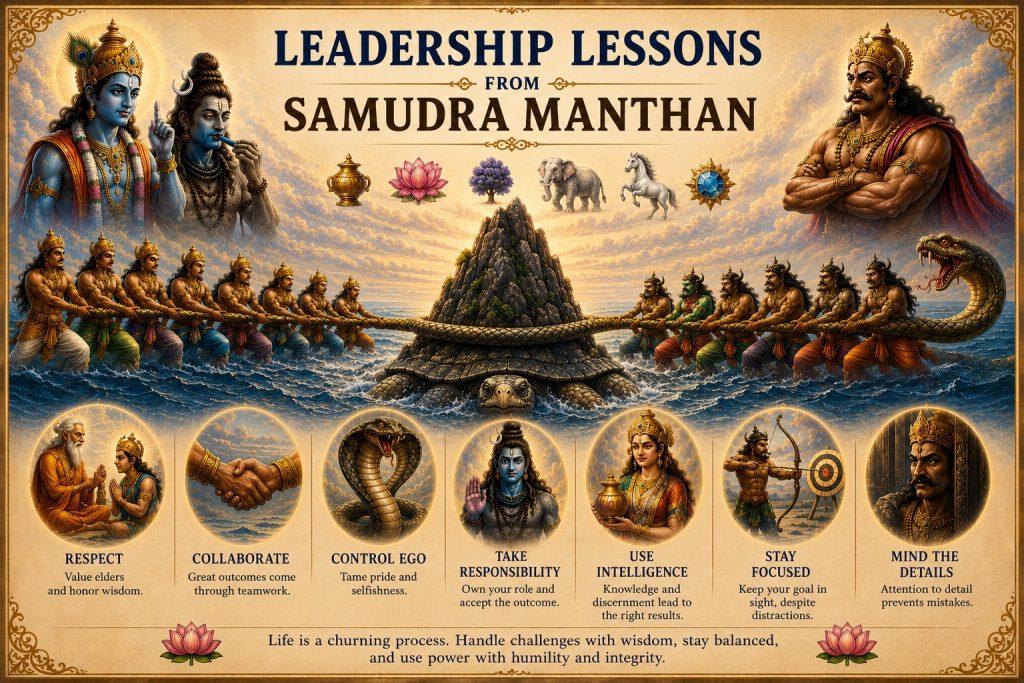
The great event became known as Samudra Manthan. To begin churning, the participants uprooted Mount Mandarachal and used it as the churning rod. The serpent, Vasuki, agreed to serve as the rope after receiving a promise of Amrit. Carrying the enormous mountain proved extremely difficult, and many devtas and asuras collapsed from exhaustion. Vishnu revived the fallen warriors, carried the mountain on Garuda, and placed it in the middle of the ocean. Vasuki wrapped himself around the mountain. Vishnu advised the devtas to hold the serpent’s head while the asuras held the tail. The asuras rejected the arrangement because they considered the tail inferior and inauspicious. As a result, the devtas accepted the tail position instead.
When the churning started, the mountain began sinking because of its immense weight. Vishnu immediately assumed his Kurma avatar and took the form of a gigantic turtle. He supported the mountain on his shell and stabilized the entire process.
As the churning continued, a deadly poison called ‘halahal’ emerged from the ocean. The poison spread toxic fumes that threatened all creation. To protect the universe, Shiva consumed the poison and held it in his throat. The poison turned his throat blue, which earned him the title Neelakanth, meaning “the blue-throated one.”
After the poison emerged, many divine treasures and celestial beings rose from the ocean. Hindu scriptures collectively describe these treasures as the Ratnas. Among the most important treasures appeared Lakshmi, who chose Vishnu as her eternal consort. Celestial dancers such as Rambha and Menaka also emerged and later joined the Gandharvas. The devtas accepted Varuni, the goddess associated with wine and pleasure. Several divine animals also appeared during the churning. These included Kamadhenu, the wish-fulfilling cow given to sages for sacred rituals; Airavata, the celestial elephant claimed by Indra; and Uchhaishravas, the magnificent seven-headed horse received by Bali. The ocean also revealed precious objects such as the Kaustubha jewel worn by Vishnu and the Kalpavriksha, the wish-fulfilling celestial tree later taken to Indraloka. Other treasures included Chandra and Dhanvantari, the divine physician who emerged carrying the pot of Amrit.
The moment Dhanvantari appeared with Amrit, the nectar of immortality, conflict erupted between the devtas and the asuras. The asuras seized the pot and refused to share Amrit with the devtas. To recover it, Vishnu transformed into Mohini, an enchanting female form of unmatched beauty. Mesmerized by her charm, the asuras trusted her and allowed her to distribute Amrit fairly. Mohini seated the devtas and asuras separately. She then secretly served the Amrit only to the devtas.
An intelligent asura named Swarbhanu recognized the deception. He disguised himself as a devta and quietly sat between Surya and Chandra. Before anyone noticed him, he drank a portion of Amrit. Surya and Chandra quickly recognized the disguise and alerted Mohini (Vishnu). Vishnu instantly used the Sudarshana Chakra to sever Swarbhanu’s head.
However, Amrit had already touched him, so he did not die. His head became known as Rahu, while his body became Ketu. Hindu mythology later connected this story with the origin of eclipses.
After the devtas consumed Amrit, Vishnu revealed his true form and returned to Vaikuntha on Garuda. Furious after realizing the deception, the asuras launched a massive war against the devtas. Empowered by Amrit, the devtas eventually defeated the asuras, reclaimed Svarga, and pushed their rivals into Patalaloka.
Who Was Swarbhanu?
Swarbhanu was the son of the asura king Viprachitti and Simhika. Hindu texts describe Simhika as intelligent, spiritually intense, ambitious, and highly powerful.
From childhood, Swarbhanu displayed extraordinary intelligence and strategic thinking. Unlike many warriors who relied mainly on physical strength, he depended on observation, disguise, planning, and psychological tactics. He questioned authority and strongly opposed the repeated dominance of the devtas.
Swarbhanu believed the asuras deserved equal respect, influence, and power. After his transformation into Rahu and Ketu, many associated him with illusion, ambition, rebellion, secrecy, obsession, and unconventional paths. Despite widespread fear surrounding him, Simhika never abandoned her son. Traditional interpretations often describe Rahu’s emotional attachment to his mother because she supported him when others rejected him.
In astrology, Rahu symbolizes intense desire, emotional hunger, attachment, ambition, illusion, and the longing for acceptance.
Leadership Lessons from Samudra Manthan and Rahu’s Story
Respect the Intent Behind Every Gift
Indra’s downfall began with a small act of carelessness. He failed to respect the sacred garland gifted by Rishi Durvasa and treated it casually.
A wise leader understands that the true value of a gift lies in the intention, trust, and goodwill behind it. Careless behavior can damage relationships and create long-term consequences. Leaders who show humility and gratitude strengthen loyalty, while arrogance often leads to the loss of trust and support.
Great Partnerships Need Collaboration and Clear Governance
The devtas and asuras remained fierce rivals for ages, yet they still cooperated to achieve a larger objective. Neither side possessed enough strength to churn the ocean alone.
Their alliance succeeded temporarily because both sides shared a common goal. However, distrust and hidden agendas eventually destroyed the partnership.
In leadership and business, organizations often collaborate with competitors to achieve growth, innovation, or survival. Successful partnerships require transparency, governance, trust, and clearly defined expectations. Without these elements, even powerful alliances eventually collapse.
Ego and Overconfidence Distort Judgment
When Vishnu advised the devtas to hold Vasuki’s head and the asuras to hold the tail, the asuras rejected the arrangement because they considered the tail inferior.
During the churning, poisonous fumes from Vasuki’s mouth severely harmed the asuras, while the devtas remained safer at the tail end.
Ego often clouds decision-making. Effective leaders focus on outcomes rather than status, appearances, or symbolism. The desire to appear superior can create avoidable problems and become the cause of failure.
Leadership Requires Responsibility and Emotional Control
When halahal threatened the universe, Shiva did not wait for someone else to act. He stepped forward, accepted the burden, and protected creation from destruction.
Strong leaders absorb pressure during crises without spreading fear or panic. Shiva holding the poison in his throat instead of swallowing or releasing it also symbolizes emotional balance and self-control.
Leadership demands sacrifice, resilience, responsibility, and the ability to remain calm during uncertainty.
Intelligence Often Defeats Raw Strength
Swarbhanu nearly achieved immortality through intelligence, timing, observation, and strategy rather than physical strength.
In modern leadership and management, strategic thinking often creates greater success than aggression or authority alone. Intelligent planning, adaptability, and awareness frequently outperform brute force.
Distractions Can Destroy Focus
When Mohini appeared before the asuras, they became distracted by her beauty and charm. Gradually, they lost focus on their real objective — securing the nectar.
Leaders and organizations constantly face distractions in the form of ego, temptation, short-term excitement, and external noise. Losing focus on long-term goals can lead to missed opportunities and strategic failure.
Disciplined focus remains one of the most important qualities of successful leadership.
Small Oversights Can Create Massive Consequences
The devtas came extremely close to securing complete victory, yet Swarbhanu managed to infiltrate their ranks unnoticed.
A single oversight changed cosmic history forever.
Strong leaders understand that success depends not only on major strategies, but also on attention to detail. Small gaps in security, planning, or governance often create the biggest future risks.
Final Thought
The story of Samudra Manthana is much more than a mythological event from ancient scriptures. It is a timeless reflection of human nature, leadership, and the inner struggles every individual faces throughout life. The narrative symbolically represents the constant tension between ambition and ethics, cooperation and rivalry, illusion and wisdom, as well as desire and responsibility.
One of the most profound messages of the story is that every person carries both Deva and Asura tendencies within themselves. At times, people are guided by discipline, wisdom, humility, and selflessness, while at other moments they may be driven by ego, greed, anger, or ambition. Life itself becomes the great churning process where these opposing forces are constantly tested.
The emergence of both poison and nectar during the churning also reflects reality. Challenges, negativity, temptations, and hardships often appear before growth, success, and wisdom. The outcome depends on how individuals handle power, emotions, desires, and responsibilities.
Ultimately, the story teaches that true victory is not simply about gaining wealth, power, or immortality. Real success lies in developing the wisdom, balance, humility, and integrity required to use those achievements responsibly.