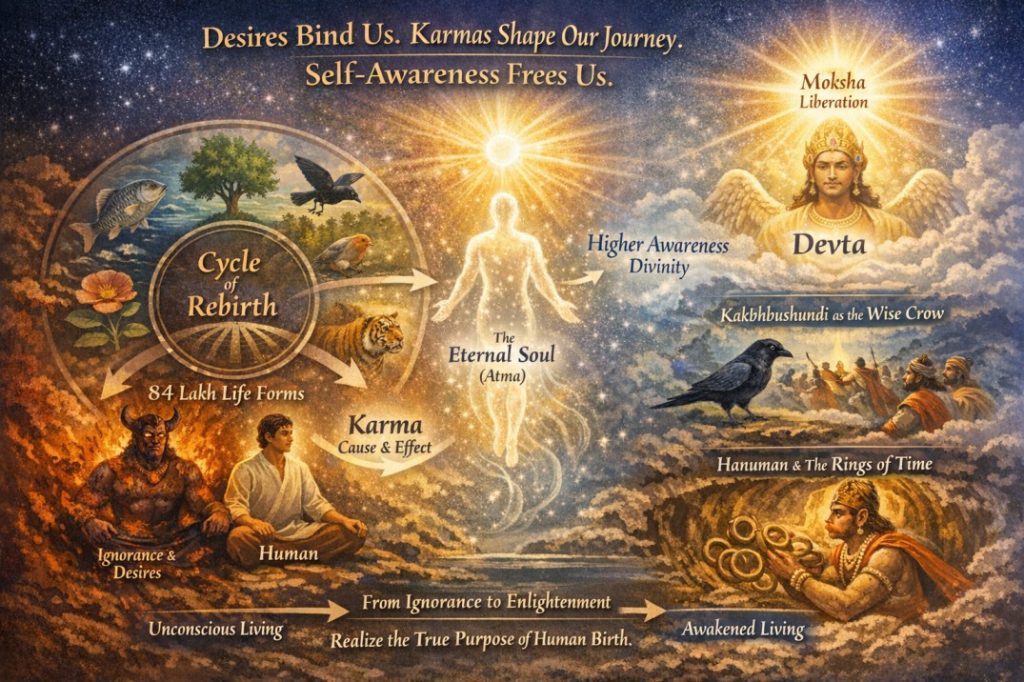
Desires, detachment, and self-awareness are not just philosophical words—they are the forces shaping our journey across lifetimes.
In our scriptures, the Atma (soul) is described as eternal. It never dies; it only changes forms. According to the Garuda Purana, after death, the soul travels through 84 lakh life forms before attaining a human birth. These include aquatic beings (9 lakh), plants (20 lakh), insects (11 lakh), birds (10 lakh), and animals (30 lakh)—forms that are largely driven by instinct rather than conscious choice.
But an interesting question arises: when we count these forms, they total around 80 lakh. What about the remaining 4 lakh?
These are said to be human-like births—as humans, Devtas, or Asuras. What distinguishes these is not the body, but the level of self-awareness. The same human form can express divinity or darkness depending on one’s awareness. A highly self-aware being evolves toward a Devta-like state, while a lack of awareness leads toward Asura-like tendencies.
This is where the law of Karma becomes central across eastern religions like Hinduism, Sikhism, Buddhism, and Jainism, karma (cause and effect) is the guiding principle. Good karmas bring peace, clarity, and wisdom. They lighten the mind and gradually lead the soul toward Moksha—liberation. Bad karmas, on the other hand, arise from ignorance, desire, lust, anger, and ego. They create inner disturbance—guilt, restlessness, and suffering—and bind us further to the cycle of rebirth.
And this brings us to the heart of it all: self-awareness.
Self-awareness truly determines our direction—whether we will attain Moksha or continue the cycle, until we learn to observe our thoughts, desires, and actions without being controlled by them. It creates detachment—not indifference, but a balanced state where we act without being enslaved by outcomes or cravings. When awareness increases, desires lose their grip. When desires weaken, actions become purer. And when actions become pure, karmas become liberating rather than binding.
Let me share a couple of stories from our scriptures.
- Kakbhushundi, once a sage, was transformed into a crow due to a mix of curses and blessings from Bhagwan Shiv and his Guru. Yet, in that form, he gained immense wisdom. He witnessed the Ramayana unfold 11 times and the Mahabharata 16 times. Despite variations in the choices of the Pandavas and Kauravas, the outcomes remained the same. This teaches a profound truth: as long as desires and karmic patterns remain unchanged, the cycle repeats—again and again. True change only comes through awareness.
- When it was time for Bhagwan Ram to leave the world and return to Vaikuntha, he knew Hanuman Ji’s deep attachment would make separation unbearable. So, he dropped his ring into a deep pit and asked Hanuman to retrieve it. When Hanuman reached the bottom, he found countless identical rings. At that moment, he realized this was not the first time this had happened— Bhagwan Ram had taken many births before. The message was subtle yet powerful: everything in this world is cyclical and temporary. Hanuman Ji’s devotion was pure, but even devotion must evolve into understanding. This story teaches detachment—not from love, but from the illusion of permanence.
And this brings us back to the essence of life:
- Desires bind us.
- Karmas shape our journey.
- Self-awareness frees us.
The difference between a human, a Devta, and an Asura is not destiny—it is awareness in action.
- When we live unconsciously, we repeat cycles.
- When we become aware, we begin to rise above them.
And perhaps, that is the true purpose of human birth—not just to live, but to realize.
This article was originally published on Linkedin.