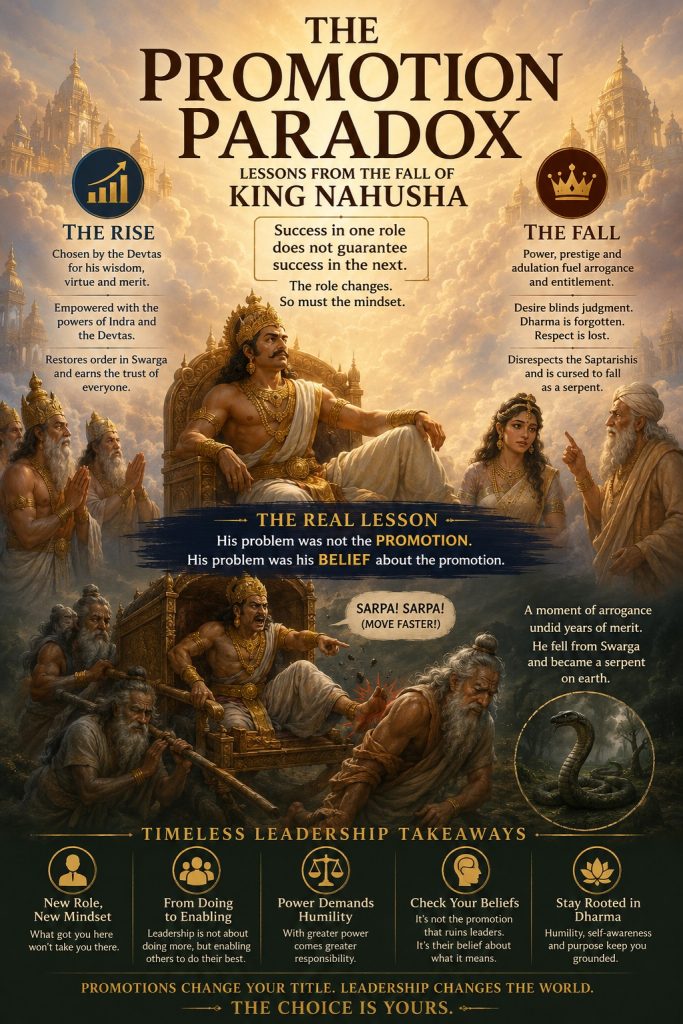
A promotion is often celebrated as recognition for past achievements. Yet every promotion comes with an invisible test. While an organization can change a person’s title overnight, transforming the way that person thinks and leads is a far more difficult journey. Many professionals rise because of their expertise, dedication, discipline, and ability to deliver results. However, leadership demands a different set of capabilities. What we might call the “Promotion Paradox” occurs when the very qualities that help an individual earn a promotion become obstacles to succeeding in the new role. Time and again, we see capable people struggle not because they lack talent or competence, but because they continue to approach their new responsibilities with the mindset that made them successful in their previous position.
Our Puranas contain a fascinating story that illustrates this paradox remarkably well: The story of King Nahusha.
The chain of events began with Indra, the king of the Devtas. Despite occupying one of the highest positions in the cosmos, Indra allowed desire to cloud his judgment. He deceived Devi Ahilya, the wife of Gautama Rishi. When the truth came to light, Gautama Rishi cursed him. Humiliated and fearful of the consequences, Indra vanished from public view and concealed himself within the stem of a lotus. His disappearance created a leadership vacuum in Swarga.
The Asuras quickly recognized the opportunity. Without Indra’s leadership, the Devtas found themselves disorganized and vulnerable. Repeated attacks from the Asuras weakened their position, forcing the Devtas and the Saptarishis to seek guidance from Brahma Ji. After hearing their concerns, Brahma Ji concluded that the heavens could not function without leadership. A new Indra had to be chosen.
The selection process was based neither on birth nor influence. The Devtas sought someone whose life demonstrated wisdom, discipline, self-mastery, and unwavering commitment to dharma. Their choice was King Nahusha, a respected Chandravanshi ruler known for his learning, righteousness, and humility. Having mastered the Vedas and Shastras and performed a hundred Ashwamedha Yagnas, Nahusha had earned admiration across the three worlds.
When approached with the offer, Nahusha did not immediately accept. He questioned whether a mortal king possessed the capability to govern Swarga and defend the Devtas against powerful adversaries. The Devtas reassured him that he would be supported by their divine powers and blessings. Eventually, convinced that he could serve a greater purpose, Nahusha accepted the responsibility.
For a time, the decision proved to be an excellent one. Nahusha restored stability, protected Swarga, and inspired confidence among the Devtas. He demonstrated many of the qualities that had originally made him worthy of the position.
But leadership tests character in ways that success never does.
Gradually, the power, prestige, and adoration associated with the throne began to affect him. The humility that once defined his personality started giving way to pride. Responsibility slowly transformed into entitlement. Instead of viewing himself as a custodian of power, he began to see himself as its owner.
The decisive turning point came when Nahusha became infatuated with Devi Shachi, the wife of Indra. Determined to make her his queen, he ignored both convention and dharma. Alarmed by his intentions, Devi Shachi sought the counsel and protection of Dev Guru Brihaspati. Together they devised a strategy to expose Nahusha’s growing arrogance.
Shachi conveyed a message that she would consider his proposal if he arrived in a manner befitting the ruler of the heavens—carried in a palanquin borne by the Saptarishis themselves. Consumed by pride and blinded by desire, Nahusha accepted the condition without hesitation.
The great sages reluctantly carried the palanquin. As they moved forward, Nahusha became impatient. The elderly Rishis could not match the speed he desired. Irritated and consumed by his own urgency, he repeatedly demanded that they move faster. Finally, losing all restraint, he kicked Agastya Muni and shouted, “Sarpa! Sarpa!” The irony is striking. While Nahusha intended the word to mean “move quickly,” the word “sarpa” also means serpent.
Agastya Muni, deeply offended by Nahusha’s arrogance and disrespect, pronounced a curse. He declared that Nahusha had forgotten dharma, abused the authority entrusted to him, and insulted the very sages whose blessings had elevated him. As a result, he would lose everything and be cast down to earth as a serpent. The curse took effect immediately. The throne disappeared. The power disappeared. The glory disappeared. Nahusha fell from the heights of Swarga and spent ages wandering the earth in the form of a serpent until the time of his eventual redemption.
The most important leadership lesson from this story is that Nahusha’s downfall did not begin with Agastya Muni’s curse. It began much earlier—when he started believing that his new position changed the rules by which he should live. His failure was not caused by the promotion itself. It was caused by the meaning he attached to the promotion.
The same qualities that earned him the throne—humility, discipline, wisdom, and service—were gradually abandoned after he acquired power. Ironically, the traits that elevated him were the very traits he stopped practicing. This pattern is not limited to our ancient scriptures. It appears regularly in organizations. Many first-time managers believe leadership means attending every meeting, making every decision, solving every problem, and being involved in every conversation. They attempt to prove their value by doing more rather than by enabling others to succeed.
Leadership, however, is not an amplified version of individual contribution. It is a fundamentally different responsibility. Success is no longer measured by personal output but by the outcomes achieved through the team. True leadership is not about accumulating authority; it is about exercising stewardship. It is not about being indispensable; it is about making others capable. And it is not about doing more work yourself; it is about creating the conditions in which others can perform at their best.
The story of Nahusha serves as a timeless reminder that every promotion demands a corresponding shift in mindset. Without that shift, the habits that once propelled us forward can become the very obstacles that hold us back.