Management Lessons from Ali Baba & Forty Thieves

Ali Baba and 40 Thieves is amongst most told stories from the Arabian world and I am sure most of you must have listened to this amazing story.  I came across this amazing story recently while preparing for my upcoming program and immediately some thoughts crossed my mind. In this post I’ll share the Management Lessons from Ali Baba & Forty Thieves. Here is the story of Ali Baba & Forty Thieves* Ali Baba and his elder brother Qasim are the sons of a merchant. After their father’s death, the greedy Qasim marries a wealthy woman and becomes well-to-do, building on their father’s business. Ali Baba marries a poor woman and settles into the trade of a woodcutter. One day, Ali Baba is at work collecting and cutting firewood in the forest, and he happens to overhear a group of 40 thieves visiting their treasure store. The treasure is in a cave, the mouth of which is sealed by magic. It opens on the words “open sesame” and seals itself on the words “close sesame”. When the thieves are gone, Ali Baba enters the cave himself and discreetly takes a single bag of gold coins home. Ali Baba and his wife borrow his sister-in-law’s scales to weigh their new wealth. Unbeknownst to them, Qasim’s wife puts a blob of wax in the scales to find out what Ali Baba is using them for, as she is curious to know what kind of grain her impoverished brother-in-law needs to measure. To her shock, she finds a gold coin sticking to the scales and tells her husband. Under pressure from his brother, Ali Baba is forced to reveal the secret of the cave. Qasim goes to the cave, taking a donkey with him to take as much treasure as possible. He enters the cave with the magic words. But in his greed and excitement over the treasure, he forgets the words to get out again. The thieves find him there and kill him. When his brother does not come back, Ali Baba goes to the cave to look for him, and finds the body quartered and with each piece displayed just inside the cave’s entrance, as a warning to anyone else who might try to enter. Ali Baba brings the body home where he entrusts Morgiana, a clever slave-girl from Qasim’s household, with the task of making others believe that Qasim has died a natural death. First, Morgiana purchases medicines from an apothecary, telling him that Qasim is gravely ill. Then, she finds an old tailor known as Baba Mustafa whom she pays, blindfolds, and leads to Qasim’s house. There, overnight, the tailor stitches the pieces of Qasim’s body back together so that no one will be suspicious. Ali Baba and his family are able to give Qasim a proper burial without anyone’s asking awkward questions. The thieves, finding the body gone, realize that yet another person must know their secret, and they set out to track him down. One of the thieves goes down to the town and comes across Baba Mustafa, who mentions that he has just sewn a dead man’s body back together. Realizing the dead man must have been the thieves’ victim, the thief asks Baba Mustafa to lead the way to the house where the deed was performed. The tailor is blindfolded again, and in this state he is able to retrace his steps and find the house. The thief marks the door with a symbol so the other thieves can come back that night and kill everyone in the house. However, the thief has been seen by Morgiana who, loyal to her master, foils the thief’s plan by marking all the houses in the neighborhood similarly. When the 40 thieves return that night, they cannot identify the correct house, and their leader kills the unsuccessful thief in a furious rage. The next day, another thief revisits Baba Mustafa and tries again. Only this time, a chunk is chipped out of the stone step at Ali Baba’s front door. Again, Morgiana foils the plan by making similar chips in all the other doorsteps, and the second thief is killed for his failure as well. At last, the leader of the thieves goes and looks himself. This time, he memorizes every detail he can of the exterior of Ali Baba’s house. The leader of the federation pretends to be an oil merchant in need of Ali Baba’s hospitality, bringing with him mules loaded with 38 oil jars, one filled with oil, the other 37 hiding the other remaining thieves. Once Ali Baba is asleep, the thieves plan to kill him. Again, Morgiana discovers and foils the plan, killing the 37 thieves in their oil jars by pouring boiling oil on them. When their leader comes to rouse his men, he discovers they are all dead and escapes. The next morning, Morgiana tells Ali Baba about the thieves in the jars. They bury them, and Ali Baba shows his gratitude by giving Morgiana her freedom. To exact revenge after some time, the leader of the thieves establishes himself as a merchant, befriends Ali Baba’s son (who is now in charge of the late Qasim’s business), and is invited to dinner at Ali Baba’s house. However, the thief is recognized by Morgiana, who performs a sword dance with a dagger for the diners and plunges it into the thief’s heart, when he is off his guard. Ali Baba is at first angry with Morgiana, but when he finds out the thief wanted to kill him, he is extremely grateful and rewards Morgiana by marrying her to his son. Ali Baba is then left as the only one knowing the secret of the treasure in the cave and how to access it. This is how this story ends for everyone happily for everyone except forty thieves. The forty thieves were rich and powerful but still they not only lost all their fortunes but also their lives. Ali Baba was neither more powerful nor smart still he managed to get everything by making best use of… Continue reading Management Lessons from Ali Baba & Forty Thieves

Govardhan Puja: Thanks Giving Day to our Parents- Lessons from our Puranas
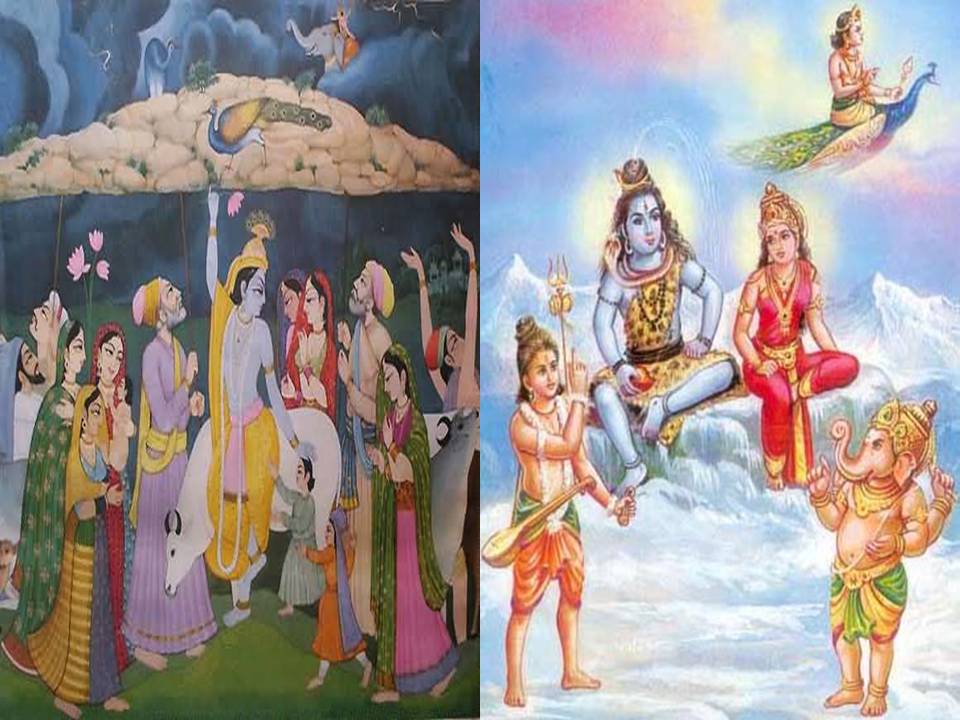
Today’s the fourth day of Diwali festival and Hindus across the world celebrate this day by performing Govardhan Puja. Govardhan Puja reminds me of stories I had learned during my childhood. In this post I’ll share those two stories and lessons from our Puranas. Story 1: Krishna was playing with his friends when he saw villagers of Varindavan carrying eatables for a Yaga to please Indra, the God of Rains. Krishna asked them why do they pray a God who’s so distant and instead they should pray Mount Govardhan which actually brings rains and provide food and shelter to so many creatures. He initiated a festival that paid respect to Mount Govardhan by offering food and many other things. Krishna then assumed the form of mountain and accepted the offerings of the villagers. Indra got very angry upon seeing shift in the devotion of villagers towards Krishna and Mount Govardhan. To teach villagers a lesson he directed lightning storm and heavy downpour upon Varindavan. To protect the villagers from the calamity, Krishna lifted the Mount Govardhan on his little finger and the entire village came under Mount Govardhan to take shelter from storm. Indra after causing such heavy downpour for seven days ultimately gave up and bowed to Krishna’s superiority. Click here to watch the story. Story 2: Once Maharishi Narad gave a divine fruit to Lord Shiv and Mata Parvati and told them that whosoever will eat this fruit will get supreme knowledge and immortality. Kartikey and Ganesha, sons of Lord Shiv and Mata Parvati, both wanted to eat that fruit and both requested their parents to give the fruit to them. Now the situation was tricky as whom to give the fruit. So Lord Shiv told them whoever will circle the entire world seven times and come back first will get the fruit. Listening this Kartikey took his vehicle, Peacock, and started his journey around the world. On the other hand Ganesha’s vehicle was mouse and he thought he can’t defeat his elder brother by riding mouse. So he thought what does the world mean to him and who’s his world. Ganesha loved his parents and whoever we love, becomes center of our lives and all our life energy goes into it. So Ganesha circled his parents, who were his world, seven times and got the blessings of his parents. Ganesha was adjudged the winner of the race. Hence he was given the divine fruit. Click here to watch the story. These two stories, and lessons from our Puranas, remind us that our parents are our Mount Govardhan and our world. All their lives they try and protect us from all the evils and difficulties. They provide nothing but the best of means to grow and help us excel in our lives. When the whole world is performing Govardhan Puja today by circling Mount Govardhan, let’s all Thank our Parents for all the sacrifices they have made and all they have done to ensure our well being and make us what we are today. May God Bless everyone’s Parents!

A Thought Well Provoked!

Have you ever thought why it is important for us to continuously improve ourselves? Here’s a Thought Well Provoked and my take on what it takes to be someone’s role model. Last week I facilitated a training program for the employees of IDBI Bank at their New Delhi regional office. It was a three days training program and everything went as per the plan and all my trainees were happy. Post session a couple of trainees wanted to talk to me regarding their future plans and seek some help on how can they do better in their lives. I spoke to them one by one and helped them with my suggestions. I was happy to see enthusiasm and the way they wanted to learn new things and explore new opportunities. By the time I finished it was quite late, I left the premises in a hurry as I was to go out with my wife. On the way to metro station I called my wife to inform that I am on the way and I shall be home in about 30 minutes. It was when I noticed some of my trainees, who were having coffee at Cafe Coffee Day, waving and inviting me to join them. As I was busy over the phone call and also was in hurry hence I just waved back and kept walking towards the metro station. While I took escalators for the metro station I realized I have committed a mistake as I should have finished my phone call, gone inside the CCD, thanked them for the invitation, shared my plan for the evening and then should have excused myself. Realizing my mistake I went back, apologized for my behavior and shared the reason for my odd behavior. They seemed happy as we spoke for some time, laughed remembering some light moments of the training program. Before departing they asked me for a group photograph and we requested a CCD team member to click`. After we got the picture clicked, I thanked the CCD member and I requested one of my trainees to share the picture with me on Whatsapp and I departed for the metro station. I was in metro when I received a friend request on my Facebook account from one of them which I accepted. In next couple of minutes I saw a picture which was tagged to me with a caption, ‘with Rohit Sir..What a Gem!!!!!!’ It was a proud moment for me as one of my trainees had written such high for me. It’s been 5 days today that I got such high regards from someone and I am really happy and overwhelmed with honor, love and respect my trainees showered upon me. But there is something which is bothering me for last 5 days and I could not sleep properly. There are some questions which are continuously haunting my mind.  ‘Am I really a Gem? Am I really worth this honor, love and respect?’ I don’t have an answer to the questions and I am not sure whether there is any answer to my questions. The only thing I know is, I am not perfect and I have many limitations and I need to a long way to be able to accept such honor. A quote from great Sufi Saint Baba Sheikh Farid perfectly explains state of my mind, “Kaale Mainde Kapde Kaala Mainda Ves, Gunhee Bhareya Main Fira Lok Kahe Darvesh” (My Clothes are Black My persona is Black, I Roam Around Full of Sins Yet People Call Me a Holy Man). I want to thank all my trainees for provoking these thoughts in my mind. I promise I’ll try and transform myself into a better human being and a better professional and live as a role model and up to your expectations. God Bless!

Lod Hai- ਲੋੜ ਹੈ

In 1675 Kashmiri Pandits (Hindus) led by Pandit Kirpa Ram came to seek help from Guru Tegh Bahadur for protection against atrocities of Mughal emperor Aurangzeb. They, on the advice of the Guru, told the Mughal authorities that they would willingly embrace Islam if Guru Tegh Bahadur, did the same. Guru Tegh Bahadur was arrested and taken to Delhi. Before departing to Delhi, Guru ji nominated his son Gobind Rai as next Sikh Guru. Guru Tegh Bahadur was put in chains and ordered to be tortured until he would accept Islam. But Mughals failed to make him accept Islam. For this Guru Tegh Bahadur was beheaded in public at Chandni Chowk on 11 November 1675. Guru Ji is known as “Hind Di Chadar” (The shield of India) as he saved Hinduism by sacrificing his life. On 13th April 1699, Guru Gobind Rai asked for five heads from his followers. Five Sikhs (Daya Ram, Dharam Das, Himmat Rai, Mohkam Chand, and Sahib Chand) volunteered to give their heads. He named them as Panj Pyare (The Five Loved Ones) and gave them mixture of Water, Patashas and Khanda (Double edged sword) as Amrit (“Nectar”) and gave them all the name “Singh” (Lion), and designated them collectively as Khalsa (the Pure Ones). The Guru then astounded the five and the whole assembly as he knelt and asked them to in turn initiate him as a member, on an equal footing with them in the Khalsa, thus becoming the sixth member of the new order. His name became Guru Gobind Singh. This is how the Khalsa Panth came into existence. Till date Hindu and Sikh celebrate this day with all the enthusiasm and valor. On the eve of tercentenary of Khalsa Panth in 1999, I was one of the devotees who had gone to Anadpur Sahib to celebrate tercentenary of birth of Khalsa Panth. When I reached Sri Keshgarh Sahib, I saw some Kashimri Pandits who had also come to pay tribute and seek blessings of Sikh Gurus. This was not the first time that Kasmiri Pandits had come to Anadpur Sahib to seek blessings of Guru Ji. Their forefathers had also come there to seek help from Guru Teg Baahadur to save them from Aurangzeb, around 325 years back. Then Guru Ji had sacrificed his life to save their lives and their faith. Whatever is happening there in Kashmir these days is almost the same and now there are hundreds of Aurangzebs but there is no one who can save the Kashmiri Pandits and their faith. My heart filled with pain and I pleaded to Guru Ji to come back and save the humanity. Following is the poem I wrote at one go sitting there and have not edited ever since: “Lod Hai- ਲੋੜ ਹੈ” Tin Sadiya Beetan Magro Main Ajj Phir Kashmiri Pandita Nu Anandpur Sahib De Qilae Wal Jaandea Dekhea Hai, Lagda Hai Aapniya Bodiaan Te Janaeouan Piche Ohna Nu Ajj Phir Kise ‘Teg’ De Sir Di Lod Hai. Te Eh Lod Ajay Khatam Hoyi Nahin Jaapdi Sago Hor Vadh Gayi Hai, Te Ajj Phir Itihaas Aapne Aap Nu Dohraan Te Tulea Hoyea Hai. ‘Jafarnama’ Likh Ke Kafara Nu Side Raah Paan Wala Pata Nahin Kithe Jaa Baithea Hai, Te Ajj Ohde Loka ‘ch ‘Kufarname’ Likhan Di Hod Hai. ‘Baazawalea’ Hun Ta Tere Baaz Vi Sehme Baithe Ne Titra De Dar To, Te Ajj Phir Tere Baaza Nu Teri Chamakdi Shamsheer Di Lod Hai. Jeeneya Merneya To Mukt Tere ‘Chali Mukte’ Dar Di Qaid ‘ch Ne Ajj Phir, Te Ajj Phir Ohna Nu Dar Di Qaid whicho Mukt Kervaan Di Lod Hai. Lagda Hai ‘Chandi‘ vi Ja Baithi Hai Machiware De Junglean ‘ch Shumb Nishumb De Dar To, Te Ajj Phir Teri Chandi Nu Teri ‘Chandi Di Vaar’ Di Lod Hai. O Jinha Sheesh Kalm Kerva Laye Per Kesha Nu Hath Na Laun Dita, Ajj Ohna Nidar Bahadara ‘ch Kesh Qatal Kervaan Di Hod Hai. ‘Kalgiyan Walea’ Je Aap Nahin Aana Ta Bhej De Koi Hor ‘Banda’ Dakhkhn To ‘Bahadar’ Bana Ke, Ajj Teri Singha Di Qaum Nu Bahadara Di Thod Hai. Tin Sadiyaan Beet Gayian Ne Sikha Nu Singh Banea, Kinjh Karange Tere Bajurg Singh Ehna Kashmiri Pandita Di Rakheya? Ajj Phir Ghol Ke Bhej De ‘Amrit’ Which Sanjivni Booti, Ajj Teri Singha Di Qaum nu Navi Taqat Di Lod Hai. Tin Sadiyaan Beetan Magro Main Ajj Phir Kashmiri Pandita Nu Anandpur Sahib De Qilae Wal Jaandeya Dekheya Hai, Lagda Hai Aapniya Bodiaan Te Janaeouan Piche Ohna Nu Ajj Phir Kise ‘Teg’ De Sir Di Lod Hai.

Har Har Mahadev- Each One in Himself (People Empowerment Perspective)

Our ancient literature and mythological books are full of stories – citing friendship, faith, dutifulness, leadership, dedication, compassion etc. Like always, I get ideas – relating their perspective to our jet age life, where I deal with people at various levels in different organizations. Being a L&D professional I have been working on bringing change to organizations and wondered if I could really link the very phrase‘Har Har Mahadev’. We all have heard this phrase several times in temples, in recitals and in prayers. The perspective clicked to me while reading about the Dharamyudha in which Lord Shiva, the Mahadev as explained by Amish in his book, coined the phrase to empower his team of warriors. I learned a new perspective of people management and people empowerment while reading this particular part in the story. It is the battle field and the entire team is ready to work for the betterment of their reign and its people. The weak, the strong, the proven and the laggards – all want to contribute and excel. Identifying traits & Leadership Style In ancient times, it was one God, one king or one leader for all. The delegation though happened in those times too but was only limited to the set of duties. The belief and onus of responsibility was put on just one person of each clan – in this case, it is the ‘Neelkanth’ – who was believed to be the messiah for the people of Meluha who waited for him to come & fight for their rights and save them from the Chandravanshi’s and the Nagas. Now the ‘Neelkanth’ has arrived who is like a new leader who is given the onus of leading the state in the best way possible, as per the rules laid by the state which has its own weaknesses and threats owing to the idealism and self belief of the population. He is trying to get into the system as he apparently is highly opinionated and believes in Karma – the good and bad. He is someone who doesn’t believe in being restricted by the man-made rules and believes in the Power of Expression, Equality and Performance over scores & class. Now isn’t that something which we all are aiming for in life and more importantly in everyday work life? We all try each day to strike a balance with our leaders (read bosses) who we want to be non-biased. A participant leader is always a welcome in a career life. It leads to mutual growth and understanding. It is the thing everybody hopes for to make the journey pleasant. Authority If a person seems important to us, we listen to that person. The person who is perceived as an outsider suddenly is been looked up to and heard of as a leader, a savior. Reason – we feel the person is important, possess power and authority and can help us gain benefit. Authority is a decisive adjective and that is why people in authority shall be chosen with great discretion and in full faith. While Shiva coined the term ‘Har Har Mahadev’ for his team, he wins hearts and trust of his team. Because he embraced authority with great liberation and he shared his power with his team by delegating the authority and empowering the meritorious. In the mentioned Dharamyudh its ‘Drapaku’ who is made the leader by Shiva for his pure talent & patriotism for the state. People Empowerment The above two are only considered worthwhile if they are used for the growth & up-liftment of the team, the resources and are made to work towards a goal which will yield results that are good to the people, the organization at large. Where it is the contribution and the result that matters most, the delegation of the team is done as per the skill-set possessed by each of them and where the sense of belongingness is inculcated deep within. The story about inception of the phrase ‘Har Har Mahadev’ guided me to the base of this human resource practice. It is about the following qualities which enable employee empowerment. When Lord Shiva told his team that it is not about him being a Mahadev but it is that each one around is a Mahadev in himself. Here, he is bringing in the concept of people empowerment and bringing in the sense of belonging which is currently practiced as ‘Employee Management & Industrial Relations’. This is what the current day HRM practices aspires for. Team, group dynamics and synergy are not just terms – they really carry a lot of meaning & weightage. The age old literature, the history vouches for it and the present day start-ups seems friendlier towards it. They value individual traits, personal skill-set, personality and interests more than the KRA, the task at hand and the targets on paper. The ancient mythological philosophies certainly carry a lot of management lessons and this is what stuck my mind when I read about ‘Har Har Mahadev’. Particularly if we talk in context of team empowerment, participant leadership, passion & compassion before rules, Lord Shiva gives me so many relevant stories.

Delegation in Ramayana (Mythology & Management)

Stories are the best ways to overcome obstacles of learning. While I was working on a leadership program I came across two stories from our mythology which helped me to explain the concept of delegation to my trainees. In this blog, ‘Delegation in Ramayana (Mythology & Management) I’ll share both the stories and how these stories explain the delegation. First Story Lord Ram helped Sugriva to regain his honor and made him king of Kishindha. Sugriva and vanars decided to help Lord Ram unite with his wife Mata Sita who was abducted by demon Ravan. The entire Vanar army was divided into four groups and sent in four directions to find Mata Sita. Hanuman, Angad and Jambavantha with their group reached the southern seashore. They met Sampati, a vulture, who tells them Mata Sita was abducted by Ravan and is sitting under a tree in Lanka, which is on the other side of the ocean. Upon encountering the vast ocean, every vanara begins to lament his inability to jump across the water. Hanuman too is saddened at the possible failure of his mission, until the other vanaras and the wise bear Jambavantha begin to extol his virtues. Hanuman then recollects his own powers, enlarges his body, and flies across the ocean. After he finds Sita in captivity, Hanuman reveals his identity to her by giving her ring of Lord Ram. He reassures her that Lord Ram has been looking for her. He offers to carry her back to Lord Ram, but she refuses his offer, saying it would be an insult to Lord Ram as his honor is at stake. She gives her jewelry to Hanuman Ji and asks him to give it to Lord Ram. Second Story To seek a peaceful solution, Lord Ram sent Angad as messengers to convince Ravana to return Mata Sita peacefully. As this was the only way to avert the war. Angada tried every means to convince Ravana, but he was firm to face battle instead of returning Mata Sita peacefully. Angada planted his foot firmly on the ground and challenged anybody in the courtroom to uproot his foot. If anybody were to accept the challenge and was successful, Lord Ram would concede defeat and return without Mata Sita. All the commanders of Ravana’s army and even his son ‘Indrajit’ tried to lift Angada’s leg but none succeeded. Feeling humiliated by this failure, an infuriated Ravana slowly walked towards Angada’s planted foot and just as he was about to hold Angada’s leg to attempt the challenge, Angada moved away and Ravana fell down. Angada explained that the challenge was for Ravana’s commanders and not for Ravana. He told that Ravana was prepared to fall on his feet but instead he should choose to fall on the Lord Ram’s feet, for those are the ones that remove fear of cycle of life & death. He then picked up Ravana’s crown which fell down on the ground and threw it out of the palace. Ravana ordered his men to kill Angada. But he took a jump and flew back to the place where the Vanara army was gathered. Lessons: Mythology & Management These two stories give us very important lessons of management in purview of Delegation. See Lord Ram as CEO of company and observe the power of delegation being expelled and carried off by him. When the thought struck my mind, I got another reason to reassure myself that management certainly is a derivative of mythology. Lord Ram, put across the problem and took up a discussion to suggest solutions. He was aware of his team strengths and weaknesses.  Lord Ram also knew about the importance of each task to their organization and the task @ hand. Accordingly as per the skill set and the importance of task – he further went on to strategic delegation among the team. That is the reason why Hanuman in story 1 was assigned the task to find Sita and to reconfirm her presence at the Ashok Vatika. He was assigned the task based on this physical skill set and presence of mind. And Sita like an ardent associate understood the importance of task delegated and din’t asked for any further help or assistance. In management context, an extension further to delegation leads to imbalance and hence grievance. And that is why the delegation holds lot of importance. Coming to the second story, Angada was delegated a task of authority. He was a messenger deployed to discuss the suggested way out, to avoid war. His skill set included assertiveness, authority, communication skills and he knew temper control which wasn’t a case with Hanuman as he was an emotional devotee of Lord Ram and would never listen to any ill words for Lord Ram. Lord Ram knew of his skill set and his power. And hence the delegation was done accordingly. These two stories embark all the 5 Stages of Delegation. Where Lord Ram, observed and realized the strengths of his team members including Hanuman, Jamavanth and Angad. He evaluated the situations and the employee skill set, he made sure of the circumstances and allowed his team to collaborate and that’s how he delegated.

God’s Companion

Have you ever wondered why do people take birth? What makes them take birth? They have friends, relatives, companions. Who is God’s companion ? Here is a small story, I was told in my childhood and the lesson to be learnt. God is one and he is the supreme power. Because God is one so he feels very lonely and he is very tired of his loneliness. He wants to have a companion with whom he can talk, play and spend time. So what he does is he makes his replica, a sculpture, of sand and then he adds life to it and examines if it is worthy enough to be God’s companion. If he finds any drawback/ weakness in his replica he throws it on mrityulok (earth). And here on earth human take birth. We are exactly like him, his true replica. We have most of his strengths and yes! some weaknesses too else he wouldn’t have sent us to earth. The day he will be successful in making his true replica, his eternal companion, he will stop making other sculptures and then no human will take birth on earth. I believe every bit of this story and I am firm believer that the mankind has been blessed tremendous potential. I wonder when people say they have so many weaknesses and only they want is to get rid of their weaknesses and not to work on their strengths. They forget that they were created by God to be his eternal companion. Story of a child There was a child, who was considered as a bully, a school dropout. Normally one would consider him to be someone who will struggle in life but this boy was different. He had a special talent of batting. He started practicing in nets for hours. When he was aged 16 years and 205 days, he was picked up to represent India against Pakistan. He made 15 runs in the first test he played and was out on a ‘duck’ in his first international one dayer. But so determined was he that he wrote history in international cricket for being the first player to score a century of centuries. There is hardly a record which is not under his name. When he decided to say good bye to international cricket after playing for 24 years and was to play his last test (200th test) at his home ground ‘Wankhede Stadium’ in Mumbai, he padded up and practiced for the whole day to prepare himself for the last innings of his international cricketing career. Cricket fans who had come there to witness him practice told reporters that he practiced so enthusiastically as if he was practicing for his first game of his career. He scored 74 runs in his last test match and when he got out and was walking towards pavilion he was still thinking he should have played his shot differently. By continuously polishing his abilities he took his career to such a level of excellence that he is became a legend. He is known as ‘Sachin.. The God of Cricket’. Believing yourself, knowing and polishing your abilities can make the difference for you as well. After all almighty had created you to be his eternal companion.  

Ashta Siddhi- 8 Divine Powers

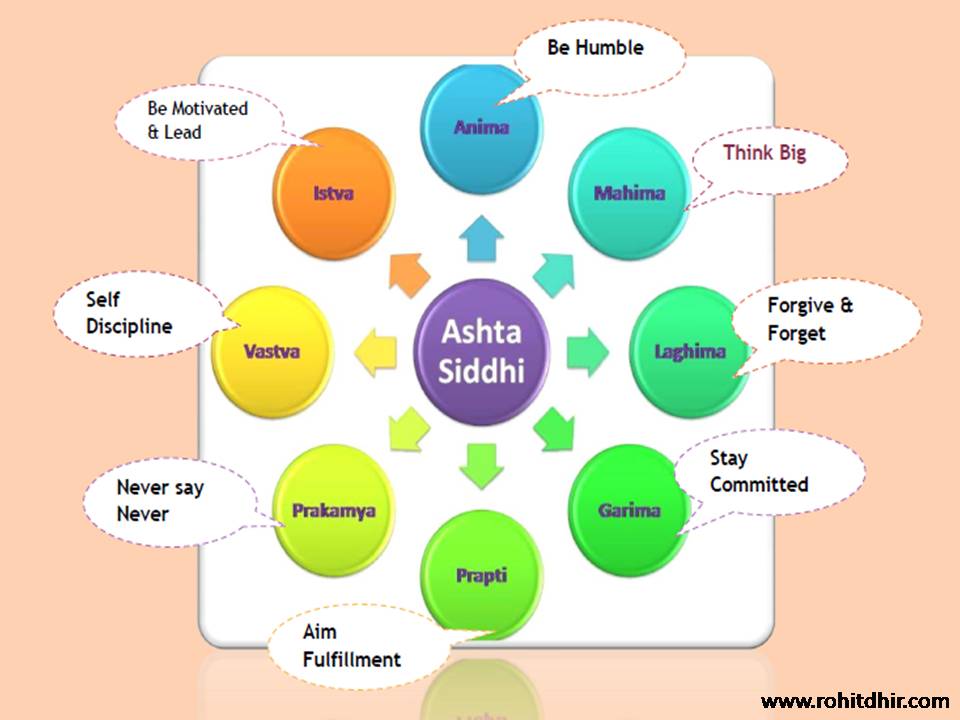
I am reading Hanuman Chalisha in morning prayers since my childhood days. I always believed that I know the meaning of all the verses of Hanuman Chalisa. Few days back while I was praying I stopped at one stanza of Hanuman Chalisa, which read ‘Ashta Siddhi Nau Nidhi Ke Data As Var Deen Janki Mata’, as I was trying to figure out the meaning of the same. After my prayers I had my breakfast and went for my Training program and I skipped exploring the same. Next day again while praying I stopped, there again, thought for a while and went ahead with the prayers. It bothered me the whole day that I am reading Hanuman Chalisa since childhood believing I know the meaning of each and every stanza of it, then how can I forget this one. I came back home and asked my wife if she knows the meaning of Ashta Siddhis and Nau Nidhi’s. Though she reads it too in her morning prayers, she was unaware about the same. Like our generation if we want to know anything about something we Google it, I did the same and take refuge of Google. I came to know Buddhi (Wisdom) and Siddhi are consorts of Sri Ganesha. There are eight types of Siddhis (Ashta Siddhis). Ganesha Ji and Hanuman Ji possess Ashta Siddhis and can give one access to Ashta Siddhis. Following are Ashta Siddhis (8 Divine Powers): Anima: Ability to become as minute as one wishes. Mahima: Opposite of Anihma. One can become as large as one wishes. Laghima: Ability to become almost weightless and travel thousands of miles in a fraction of second. Garima: Opposite to Laghima. Ability to become infinitely heavy. Prapti: Ability to touch the highest things (Moon, Sun & even the stars), to attain desired objects, ability to predict future events, ability to telepathy and thought-reading, etc. Ability to understand the languages of the beasts and birds and understand unknown languages. Ability to cure all diseases. Prakamya: Ability to realize whatever one desires. It is also defined to be the power of entering body of another (Parakaya Pravesh). It is also the power of keeping a youth-like appearance for any length of time. Vastva: The power of taming wild animals and mesmerizing people to control them. Istva: The ability to restore life to the dead. I wondered if such divine powers are available for mankind today then how our world will look like. More prosperous or More peaceful! As a science graduate, if I take into consideration whatever I learnt in Physical Sciences, it seems impossible to have such powers. How can one go against the law of gravitation and become so light that he can fly and reach wherever he wants? How can life be restored to a dead? Can one increase or decrease his height or take shape of some other person/animal? It triggered a thought in my mind: Are these actually divine powers or some hint towards unexplored potential of human beings? And if one can explore his full potential he can certainly do wonders. I feel this is all related to the power of faith and will-power. Like they say, if you wish to – you will do. What I could figure out Ashta Siddhis (8 Divine Powers) which one can achieve are as follows: Aṇima : One can become small by being humble and leaving ego and anger. Mahima: Thinking Big and helping others to be big. Laghima: No grudges whatsoever. To forgive and forget. Garima: To keep ones commitment. Prapti: Ability to install your vision in others hearts and minds and to achieve your aim. Prakamya: Never say never attitude and ability to reform and adapt as per the situation. Vastva: Ability to self discipline and defeat ones bad habits. Istva: Ability to lead and motivate. I hope I could make sense through this post for I believe in power of self belief and faith.

TEDx Gurgaon 2012 – Ever thought about taking the Road Less Traveled?

Saturday the September 1st, was another day of learnings and experience. After a hectic week of travel and meetings, I really thought it would be difficult to sit through a Saturday and listening to people. But then, I decided to give it shot – Ah! My love for meeting the people – who have believed in themselves and are walking the road less travelled. The conference began with ‘Chris Anderson’s talk on TEDx and with that we were all set to start the day of learning & networking. The Opening was by Abhinandan Chatterjee and he spoke about – ‘How to take the road less taken, everyday!’ I have heard him in the last years TEDx meet and I remembered the tiny bits of wisdom he had shared then so I was all ears. Though the theme was little abstract but I simply loved what he had to say about the road less travelled. He just urged everyone to W.A.L.K. W: What is the worst that could happen? A: All in the moment. L: Learn to learn. K: Keep Happiness ready. And yes, why can’t we just make it simple. Like they say, if you are ready for the worse – the bad can never affect you. And if we decide to live it all in the moment, we will never be caught in the hassles and worry of what might/will happen? We shall all learn to live in the moment and keep our learning nerves active. And believe me; if we can do it all we have our happiness ready. I am sure, we got a great message and now we know how significant it is to take a walk, everyday. …. The second speaker of the day was Ashish Sachdeva, a young enthusiast who ventured into and established Green Dream Foundation– well we can say that’s how he decided to do his bit for the environment and be an advocate for young & old to empower them for healthier and environment friendly activities. He talked about “Going Green, Just a trend or more”! He touched the basics for the understanding of the audience and covered why sustainability is a most required and how we are playing ignorant about the same. The video he shared with people reviews on the subject left the audience wondering – where do we stand in the lot? A simple yet thought evoking session which ended with a sane advice for the audience. …. After a refreshing tea break and some connections –the enthralled audience came back with zest to listen to – Aditi Rao who spoke about –”Peace, and possibilities of the poetry in classroom“. Honestly, her talk was abstract and inspiring but a difficult one to understand. She talked about the Drivers of openness and how empowerment is defined as a correct distribution of knowledge and power. And this empowerment so gracefully leads one to creativity and imagination. Why and how peace can only be understood through empathizing. I specially loved the way she spoke about Metaphors and how vulnerable they can be at times, I am sure the audience could very well resonate on that. ….. Post this we had a great TED video by Don Tapscott on the “Four Principles for Open World”. Quite an intriguing talk by Don on how he feels his children are turning to prodigy and how technology has changed the world by opening up and how this has made the world a better place. ….. The conference was reaching lunch hour and we had Mr.Abhijit Bhaduri, his presentation topic caught all the attention and we were on to explore. The subject was ‘It depends on the question’. Wow! A very creative way to present – he had all the slides with sketches and the message was coming straight. Now this wasn’t just learning – he just brought an experience right there on the screen. His story telling was amazing and how a question leads to answers – sometimes perfect and sometimes weird. The audience loved the way he narrated on how he thought that one has to be reasonable & practical in making choices and the way he thought on it when he got to know that his kid wanted to be ‘Hanuman’. Abhijit had some plain straight messages for everyone that, when you have decided to take the road less travelled one should start ignoring the irrelevant. Irrelevant like, what is everyone doing? Instead, we should always ponder about things like – What do I enjoy doing? What am I good at? Have I progressively abandoned my hobby? And then we shall make a choice. And whether it is the road less travelled or not, we must follow the right answers we get as ‘it depends on the question’. ….. Post lunch there was an intriguing TED Video where Arianna Huffington shared her thoughts on – “How to Suceed? Get some sleep” And her mantra to big ideas was a very small idea – Get some sleep. A humor filled video where she makes us believe that – to lead to better ideas and better decisions in life, all we need is sleep as bragging about sleep deprivation will lead everyone to – nowhere. A very convincing talk on how sleep can lead to more happiness and better productivity. ….. In the later part of the session, we had some amazing people to listen to. Certainly, they were different, they stood out and their work, their story speaks for them. The session began with Dr.Latika Rana’s talk on “Born to be Wild”. We all have heard about campaigns like ‘Save our tigers’ but listening to her was like getting to the root cause of it and living the life from jungle. I loved it because, I was awed by her decision to work in wildlife conservation. No wonder, she is aptly dubbed as the ‘tiger princess’. Not many could take up this kind of a work, she shared some beautiful memoirs of her… Continue reading TEDx Gurgaon 2012 – Ever thought about taking the Road Less Traveled?